What's for Dinner Tonight? How a Free Spin Wheel Ends the Nightly Food Debate
"What do you want to eat?" "I don't know, what do you want?" If that exchange happens in your kitchen most nights, a free digital spin wheel can end it in under a minute — no app, no sign-up, no more standing in front of an open fridge at 6pm.
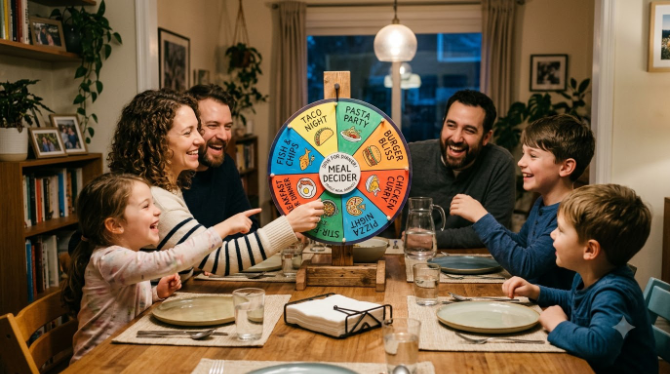
A dinner wheel turns "I don't know" into a decision in seconds.
- Why "What's for Dinner" Is the Hardest Question of the Day
- How a Spin Wheel Actually Fixes the Problem
- Building Your First Dinner Wheel in 5 Steps
- 35 Dinner Ideas, Sorted by How Much Energy You Have
- Cuisine Wheels: For When You Want to Cook, Not Just Eat
- Different Households, Different Wheels
- Using a Wheel to Pick Where to Eat Out
- Common Mistakes That Make a Dinner Wheel Fail
- Advanced Tips: Weighting, Seasons & Rotations
- Frequently Asked Questions
- Final Thoughts
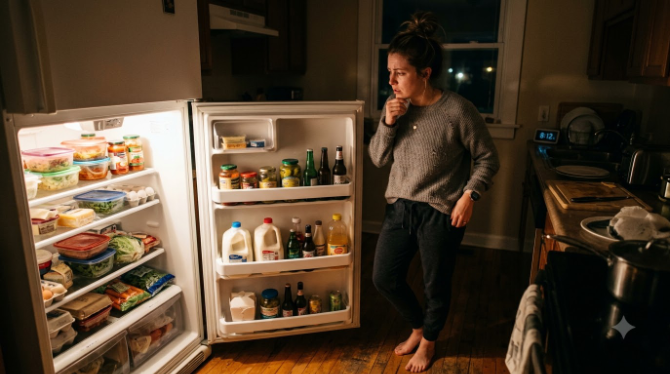
It happens at almost exactly the same time every evening. Someone's stomach growls, someone else opens the fridge and stares into it as if the answer is hiding behind the ketchup, and the question gets asked: "What do you want for dinner?" What follows is rarely a plan. It's usually a stalemate — "I don't mind," "whatever's fine," "you pick" — that somehow eats up half an hour and ends with everyone slightly annoyed and a pizza on the way.
This isn't a willpower problem or a sign that your household can't communicate. It's a known cognitive pattern called decision fatigue: after a day spent making dozens of small choices — what to wear, which email to answer first, whether to take the call — your brain's appetite for one more open-ended decision is genuinely lower by evening. Dinner, which involves everyone's mood, dietary needs, and what's actually in the pantry, is exactly the kind of decision that fatigue hits hardest.
The fix that's quietly caught on in a lot of households this year is almost embarrassingly simple: a free online spin wheel. Load it once with meals everyone's already agreed to, and let it make the call every night. No back-and-forth, no one person always being the default decider, no 30-minute negotiation before anyone's even turned the stove on.
1. Why "What's for Dinner" Is the Hardest Question of the Day
The trouble isn't a shortage of options — most households can name fifteen or twenty meals they'd happily eat again. The trouble is getting more than one person to land on the same meal, at the same time, while also accounting for what's actually in the fridge, how tired the cook is, and what got made three times already this week.
Researchers who study choice describe something called the paradox of choice: having more options doesn't make a decision easier, it makes it harder, because now you also have to weigh whether you're picking the "right" one. When literally anything is acceptable, nothing feels worth actually committing to — which is exactly how "I'm fine with anything" ends up producing no dinner plan at all.
A spin wheel sidesteps the whole standoff. Because every option on the wheel was added by agreement beforehand, the wheel isn't picking for anyone — it's just revealing which of the choices you already approved happens to be tonight's.
2. How a Spin Wheel Actually Fixes the Problem
A coin flip, a dice roll, and "let's just take turns" are all reasonable ways to make a random choice — so why does a spin wheel work better than any of them for dinner, specifically? A few reasons stand out once you actually use one for a few weeks:
3. Building Your First Dinner Wheel in 5 Steps
You can have a working dinner wheel ready before the kettle boils. Here's the exact process:
4. 35 Dinner Ideas, Sorted by How Much Energy You Have
If your wheel feels empty, here's a starting list organized by effort rather than cuisine — because on a Tuesday, how much energy cooking will take often matters more than what kind of food it is. Swap freely for whatever your household actually eats; a generic list is just a starting point.
| Category | Meal Ideas | Effort Level |
|---|---|---|
| 🍳 15-Minute Fixes | Quesadillas, egg fried rice, beans on toast, instant noodle upgrade, omelette & salad | Very Easy |
| 🍝 Pasta & Grains | Tomato pasta, baked ziti, garlic butter orzo, mushroom risotto, mac & cheese | Easy–Medium |
| 🍗 Poultry | Sheet-pan chicken thighs, chicken tinga tacos, honey-garlic stir-fry, roast chicken, chicken shawarma bowls | Easy–Medium |
| 🥩 Beef & Lamb | Smash burgers, one-pot beef chili, lamb kofta, beef & broccoli, shepherd's pie | Medium |
| 🐟 Fish & Seafood | Sheet-pan salmon, shrimp tacos, garlic butter prawns, tuna melt, baked cod & veg | Easy–Medium |
| 🌱 Plant-Based | Chickpea curry, black bean bowls, lentil soup, veggie fajitas, stuffed sweet potatoes | Easy |
| 🍕 Zero-Cook Nights | Pizza delivery, sushi order, favorite curry house, poke bowls, burrito run | Zero Effort |
5. Cuisine Wheels: For When You Want to Cook, Not Just Eat
If your household enjoys cooking and can improvise within a style, try a cuisine-first wheel instead of a dish-specific one. Rather than landing on "chicken tikka masala," the wheel lands on "Indian," and whoever's cooking decides the specific dish from there. This works especially well when one person genuinely enjoys the creative side of cooking — the wheel gives them a direction without dictating every ingredient.
- Italian — pasta, pizza, risotto
- Indian — curry, dal, biryani
- Japanese — sushi, ramen, teriyaki
- Mexican — tacos, quesadillas, enchiladas
- Middle Eastern — kebabs, mezze, shakshuka
- Thai — green curry, pad thai, noodle salad
- Chinese — stir-fry, dumplings, fried rice
- Comfort classics — roast dinner, pie, mash
- Chef's choice — whatever inspires you tonight
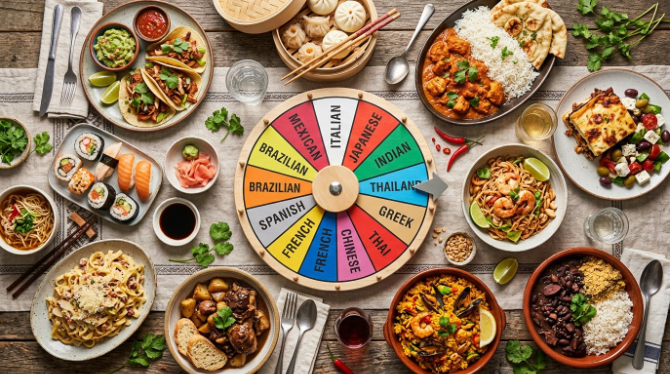
A cuisine wheel also naturally builds in variety. Because each spin lands on a whole food tradition rather than one dish, you're less likely to end up eating some variation of pasta four nights running without noticing.
6. Different Households, Different Wheels
A dinner wheel that works for a family of five needs a different setup than one built for a single person deciding solo. Here's how to configure each:
How to build it: Run a short 10-minute family session where everyone suggests meals — anything with a firm veto from someone at the table gets left off. What's left is a wheel nobody can reasonably object to later.
A useful addition: Add a "Kids' Choice" and a "Grown-ups' Choice" entry, each acting as a wildcard where that group picks freely from their own shortlist. It keeps everyone's sense of agency intact while the wheel still handles the actual decision.
How to build it: Use two wheels in sequence. Wheel one: "Cook or order" — spin this first. Wheel two: the actual meal, matched to whichever outcome the first wheel gave you. Two quick decisions beat one long, open-ended one.
7. Using a Wheel to Pick Where to Eat Out
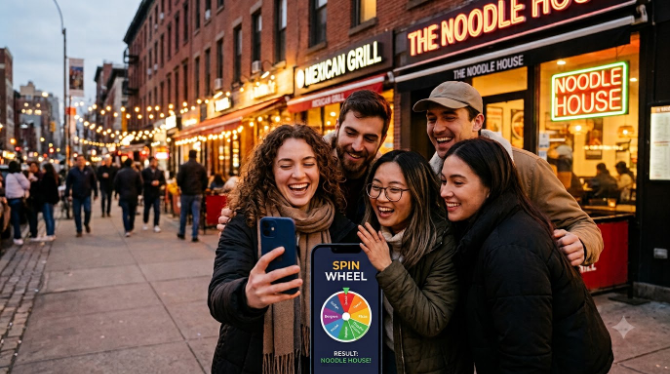
The dinner wheel isn't limited to home cooking. One of the most common uses is solving the "where should we eat?" loop when you're heading out or ordering delivery. Here's a setup that works well for restaurant decisions specifically:
8. Common Mistakes That Make a Dinner Wheel Fail
Most households that give up on a dinner wheel after a week or two aren't failing at randomness — they're running into one of a handful of predictable setup problems. Here's what usually goes wrong, and the quick fix for each:
9. Advanced Tips: Weighting, Seasons & Rotations
🎡 Ready to Try It Tonight?
Our free Spin the Wheel tool works on any phone, tablet, or laptop. Build your dinner wheel in under 60 seconds — no sign-up, no cost, ever.
Open Free Dinner Wheel →10. Frequently Asked Questions
How many meals should I put on my dinner wheel?
Somewhere between 10 and 16 works well for most households. Fewer than that and you'll cycle through the list too fast to feel like real variety; more than 25 and individual meals rarely get picked, which makes the wheel feel arbitrary rather than useful. Start with your most-cooked weeknight staples and adjust from there.
For a full walkthrough of how the tool handles entries, see our complete guide to the Spin the Wheel tool.
Is the spin genuinely random?
Yes. The outcome is determined by a pseudo-random number generator the instant you hit spin — the animation that follows is a visual reveal, not something that can be timed or influenced by when you click.
For the technical detail, see our article on whether a digital spin wheel is truly random.
What if someone doesn't want what the wheel picks?
This is exactly why the "wheel is final" rule matters, and why it's set before the first spin, not negotiated after. If everyone agreed to add a meal to the wheel, everyone agreed to eat it if it comes up. One meal that doesn't excite someone every so often is a much smaller cost than the negotiation it replaces.
If a particular dish causes resistance more than once, that's useful feedback — take it off the wheel rather than arguing about it each time it lands.
Can we use the wheel on a TV or shared screen at dinner time?
Yes — open it in a browser and cast to a smart TV or connected display, then spin in fullscreen for the full effect. It turns the daily decision into something the whole table watches together rather than a phone one person checks alone.
How is this different from a meal-planning app?
Meal-planning apps ask for upfront weekly effort — building a plan, a shopping list, a schedule. A dinner wheel flips that: set it up once, then spin each evening with almost no ongoing effort. It's less structured, but for a lot of households that's exactly why it's the one that actually gets used week after week, instead of the meal plan that gets abandoned by Thursday.
Can I use a wheel for other food-related decisions?
Definitely. The Yes or No Wheel works well for quick binary calls like "cook or order?" or "meat or veggie tonight?" — and the same logic applies to snack decisions, weekend brunch, or dessert picks. For more inspiration, browse the 10 best uses of a random wheel spinner you haven't thought of.
11. Final Thoughts
Dinner decision fatigue is one of those small daily frictions that never feels like a big deal on its own, but quietly costs a real amount of time and patience across a week. A free spin wheel won't plan your groceries or cook your meal for you — but it will end the 30-minute loop of "I don't know, what do you want?" with a ten-second spin and nothing left to argue about.
The part that actually makes it work is the agreement built in from the start: every meal on the wheel is already approved. Once it lands, there's nothing left to negotiate — just dinner to make. That's the whole trick, and it's why households that try it once tend to keep using it.
Whether you're feeding a family of five, splitting delivery decisions with a partner, or just trying to stop scrolling food apps solo for twenty minutes, a dinner wheel is worth the two minutes it takes to build. Head to spinthewheelsonline.com, add your meals, and spin for tonight.
- Dinner indecision is decision fatigue, not a communication problem — a spin wheel removes the cognitive load, not just the debate.
- Pre-loading the wheel means pre-approving every outcome, so there's nothing left to veto after the spin.
- Start with 10–14 entries, refresh seasonally, and check the list against your fridge after each grocery run.
- Build separate weekday and weekend wheels to match different energy levels.
- Agree the "wheel is final" rule before the first spin — it's the one rule that makes the whole system work.
- Pair it with the Yes or No Wheel for quick binary calls like "cook or order?" before spinning the full meal wheel.
- The same approach works well beyond dinner — see how it applies to family game nights and other everyday decisions.
🎡 Try It Free Tonight
Build your dinner spin wheel in under 60 seconds. No sign-up, no download — works on every device, completely free.
Open Wheel Spinner →