- A Coin Flip Hurts Less Than a Bad Choice
- Decision Fatigue Is a Real, Depletable Resource
- Procedural Fairness Beats Outcome Fairness
- The Quiet Biases Behind "Fair" Human Selection
- Why a Spinning Wheel Holds a Room's Attention
- The Regret Gap Between Chosen and Random Outcomes
- Why We're Often Happier With What We Didn't Pick
- Where This Shows Up in Real Life
- Frequently Asked Questions
- Conclusion
Picture two nights out. On the first, you and a friend spend ten minutes weighing two restaurants, land on one, and the food is mediocre. On the second, you flip a coin, it sends you to the same mediocre meal. The food is identical. Your reaction usually isn't. The chosen bad meal tends to sit with you — you start replaying the decision, wondering what you missed. The random bad meal is easier to laugh off.
That gap isn't irrational. It's a predictable feature of how people process responsibility, fairness, and regret — and it's the same psychology that explains why tools like a spin the wheel tool show up everywhere from classrooms to team stand-ups to family dinners. Not because randomness is magic, but because it sidesteps a set of very specific mental costs that deliberate choosing carries with it.
This piece walks through what's actually happening — psychologically and neurologically — when a decision gets handed to chance, and where that handoff genuinely helps versus where it doesn't.
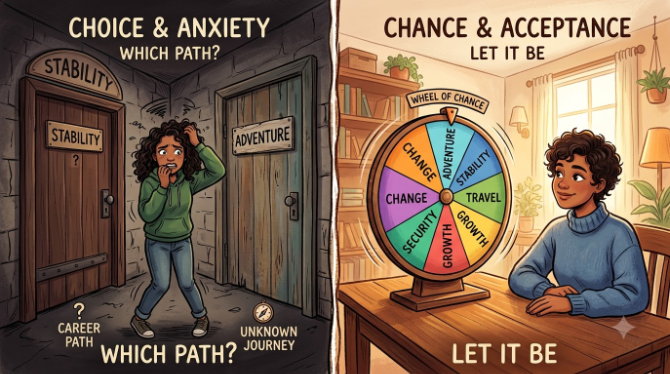
Six psychological mechanisms explain why handing a decision to chance often works better than it should: decision fatigue, procedural fairness, bias in human selection, uncertainty-driven attention, asymmetric regret, and the comfort of a closed loop.
1. A Coin Flip Hurts Less Than a Bad Choice
When you choose something yourself, your brain links the outcome straight back to your own judgment. That link is what psychologists call attribution — the mental habit of assigning a cause to an event. Choose well, and you feel sharp. Choose badly, and the sting is personal, because there's a clear "you" at the other end of the decision.
A random process breaks that link. The outcome still happens, but there's no judgment call to trace it back to — just a process that ran the same way it would have for anyone. Your brain treats that differently: not as an excuse to dodge responsibility, but as a genuine break between "what happened" and "what I decided." People consistently report feeling more at peace with outcomes they had no hand in choosing, especially in situations where someone was always going to end up disappointed.
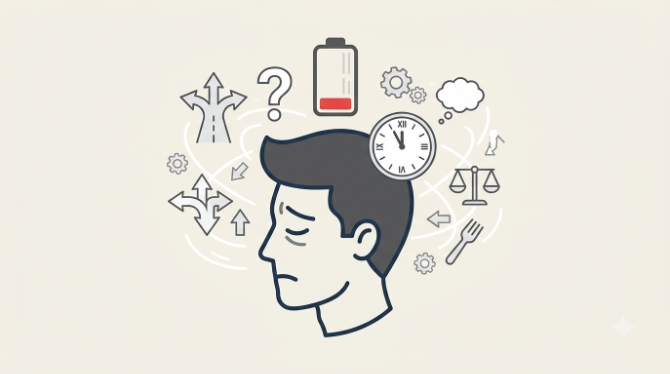
2. Decision Fatigue Is a Real, Depletable Resource
Every deliberate choice draws on the same limited mental fuel — the part of your brain responsible for weighing options and predicting outcomes gets a little more tired with each one. This is decision fatigue, and it's well documented in fields as different as retail checkout behaviour and judicial rulings: decision quality tends to drift as the number of decisions made that day climbs, regardless of how important any single one is.
Random tools sidestep that cost almost entirely. Spinning a wheel to settle "what's for dinner" isn't a decision — it's the execution of one. Multiply that across a day full of trivial choices, and the cognitive room you free up for the decisions that actually deserve your attention adds up.
This is exactly why a Yes or No Wheel earns its keep on the small stuff — not the hard calls, but the constant low-stakes ones that quietly drain the same mental battery you need for the decisions that matter.
What this looks like in practice
The dozens of minor calls a team makes in a day — who presents first, which task goes to whom — aren't harmless friction. They're spending cognitive capacity that's better saved for real strategy. Teams that use a wheel for these micro-decisions aren't cutting corners; they're protecting their attention for where it counts.
3. Procedural Fairness Beats Outcome Fairness
There's a useful distinction in fairness research between outcome fairness (did I get a good result?) and procedural fairness (was the process that produced the result fair?). Across a wide range of studies, procedural fairness turns out to matter more for how satisfied people stay over time. People will tolerate a worse result if they trust the process. They'll resent even a good result if the process feels rigged.
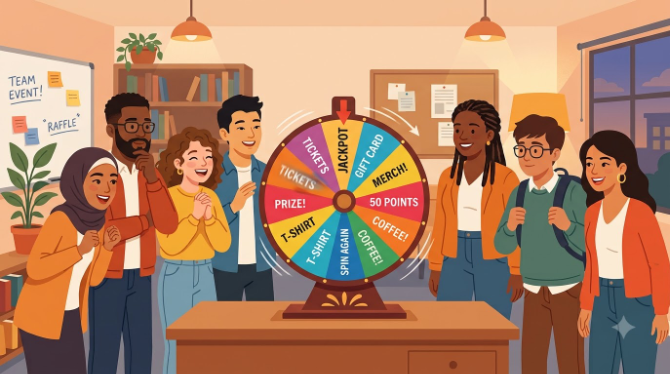
A visible random mechanism — a wheel spun on a shared screen, a public raffle draw — scores about as high on procedural fairness as a process can. Everyone sees the same thing happen. No one could have tilted it. There's nothing left to argue with.
Calling on Students
When a random wheel picks who answers, students stop reading the choice as a comment on how the teacher sees them.
Assigning Tasks
Manager-picked assignments quietly breed resentment over who gets the good projects. A visibly random pick removes that target entirely.
Picking a Winner
An unseen selection process invites suspicion. A recorded live spin is its own proof — see our guide on running a fair online giveaway.
Small Disputes
Kids push back far less on a wheel's verdict than a parent's ruling, because there's no authority figure left to argue against.
4. The Quiet Biases Behind "Fair" Human Selection
Even well-intentioned people don't select randomly. A handful of well-documented mental shortcuts nudge human choices away from true fairness without anyone noticing it happening.
-
Availability biasWe reach for whoever or whatever comes to mind first — the name we just read, the person who spoke last — regardless of merit.
-
Halo effectOne good impression colours everything after it, so the same few people keep getting picked.
-
Status quo biasWe default to the familiar — the same volunteers, the same go-to team member — even when we're trying not to.
-
Affinity biasWe unconsciously favour people who feel similar to us, quietly sidelining anyone who doesn't.
-
Confirmation biasWe pick the person we already expect to succeed, which only ever confirms what we assumed.
-
Fake-randomness biasWhen people try to "look random," they overcorrect and avoid repeats far more than genuine chance ever would.
A genuine random tool has none of this baggage. It doesn't know who spoke last or who feels familiar. That's often exactly why random selection surfaces people and outcomes a human picker would have quietly filtered out.
Most people rate themselves as less biased than they actually are — including the people doing the picking. It's not a character flaw, it's just how attention and memory work. Which is exactly why an external, indifferent process is worth more than good intentions alone.
5. Why a Spinning Wheel Holds a Room's Attention
Brains are prediction machines. They're constantly forecasting what's about to happen and paying closer attention when that forecast is genuinely uncertain. A volunteer-based cold-call lets most of a room switch off, because most people already know they won't be picked. A spinning wheel keeps everyone's "it might be me" prediction alive until the moment it stops — and holding that prediction takes active attention.
That's the underlying reason teachers notice sharper focus the moment a wheel comes out: the uncertainty itself is doing the work, without the teacher having to do anything differently.
An outcome you can't yet predict holds attention longer than one you already know. Uncertainty is, almost by definition, worth watching.
The same mechanism is behind family game night formats and streamer challenge segments — a live spin creates a short window of shared, genuine suspense that a predictable outcome simply can't produce.
The reward-anticipation angle
There's also a well-known finding from reward psychology: people respond more strongly to uncertain rewards than to guaranteed ones. Not knowing whether or when a payoff will land tends to sustain motivation longer than knowing for sure. A wheel spin is a small, safe version of that same uncertainty, which is part of why it's oddly satisfying to watch even when nothing's riding on it.
6. The Regret Gap Between Chosen and Random Outcomes
One of the steadier findings in decision research is that people feel worse about a bad outcome that followed their own active choice than about an equally bad outcome that came from doing nothing or from a process outside their control. Psychologists call this an action effect: the act of choosing amplifies regret, even when the physical result is identical either way.
Apply that to everyday selection — a picked restaurant disappoints, an assigned project turns out tedious, a chosen teammate underdelivers — and random selection consistently softens the blow. There's no decision-maker left to blame, including yourself. That's genuinely useful for anyone who has to make repeated calls that will sometimes go wrong: managers, teachers, parents.
Beyond fewer complaints, people who hand routine assignment decisions to a random tool often report less personal stress about them. Knowing a fair process picked the outcome — not your own judgment — takes the edge off the anticipatory worry that makes small management decisions feel bigger than they should.
7. Why We're Often Happier With What We Didn't Pick
Here's the part that seems backwards: people are frequently more satisfied with outcomes they didn't choose than with ones they agonised over. More control should, in theory, mean more satisfaction. In practice, it often doesn't.
Too many good options
The more options on the table and the longer you deliberate, the higher your expectations climb — and the bigger the letdown when reality doesn't match them. A random pick carries none of that built-up expectation. You get what you get, with no "it should have been better" yardstick to measure it against.
Making peace with the result
People are also good at finding reasons a random outcome is actually fine, or even interesting — a habit psychologists call post-decisional rationalisation. Students randomly assigned an unfamiliar topic for a project often end up more engaged with it than students who picked something safe and familiar, partly because the randomness itself sparks curiosity.
A decision that actually closes
Open decisions quietly use up mental bandwidth even while you're doing something else — the itch of an unresolved choice sitting in the back of your mind. A spin closes that loop instantly. Once it lands, there's no re-litigating it. That finality is a big part of why the moment feels satisfying, independent of what the wheel actually landed on.
8. Where This Shows Up in Real Life
None of this is theoretical. Here's how each mechanism maps onto the situations people actually use a spin wheel for:
🏫 Classrooms
Uncertainty keeps attention up (Section 5), fairness lowers social anxiety (Section 3), and bias removal means quieter students actually get called on (Section 4). See our classroom activities guide.
💼 Remote Teams
Less decision fatigue (Section 2), less meeting-role resentment (Section 3), and easier assignment calls for managers (Section 6). Full guide: spin the wheel for remote teams.
🎁 Giveaways & Raffles
Visible fairness builds trust, and a live spin gives closure that nothing else does. See running fair online giveaways and school raffles.
👨👩👧 Family Decisions
Takes the parent out of the line of fire for small disputes and settles them faster than debate ever would. See family game night ideas.
🎮 Games & Streams
Uncertain outcomes sustain engagement on their own — no extra effort needed from the host. Used widely by streamers and creators.
🤔 Personal Decisions
Best suited to low-stakes calls where deliberating is costing more than the choice is worth. Try the Yes or No Wheel for these.
🎡 Try It on a Decision You're Stuck On
The easiest way to feel the difference is to build a wheel for something you're currently going back and forth on, and notice your own reaction the second it lands.
Open Free Wheel Spinner →9. Frequently Asked Questions
10. Conclusion
The psychology here isn't an argument for laziness — it's a case for being honest about which decisions actually need your judgment and which are just quietly draining it. Deliberate choice has real costs: cognitive, social, emotional. Random selection sidesteps most of them at once. It cuts decision fatigue, maximises how fair a process feels, removes the usual human biases, holds attention through genuine uncertainty, softens regret, and closes the loop in a way that drawn-out deliberation rarely manages.
None of that means every decision belongs to a wheel. It means the low-stakes, frequent, roughly-equal ones probably do — and letting go of those isn't a surrender, it's just good use of a limited resource.
Try it at spinthewheelsonline.com, or read more in our guides on the best uses of a random wheel spinner, how it compares to other random pickers, and the science of its randomness.
- Random outcomes are accepted with less regret than chosen ones, even when the result is identical.
- Decision fatigue is cumulative — offloading small choices protects capacity for the ones that count.
- A process feeling fair matters more for satisfaction than the outcome itself being good.
- Human selection carries built-in biases that a genuine random process simply doesn't have.
- Shared uncertainty during a live spin creates real, collective attention.
- A visible spin adds the felt experience of fairness — not just the fact of it.