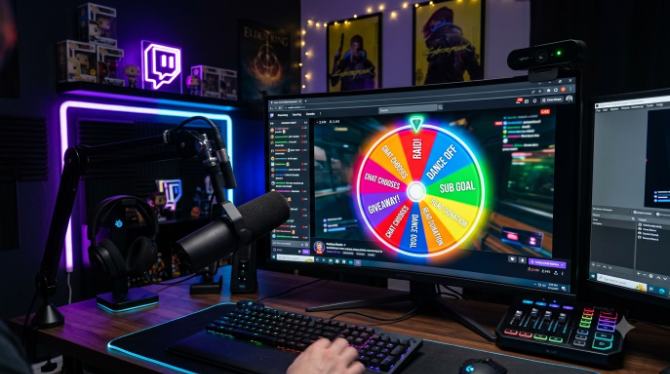
- Why a Wheel Segment Outperforms Scripted Content
- Six Wheel Formats Creators Actually Use
- Gaming Randomiser Wheels, in Detail
- Subscriber Dare and Challenge Wheels
- Charity Milestone Wheels That Drive Donations
- Letting the Audience Co-Author the Wheel
- Formats That Work Especially Well on YouTube
- Wiring the Wheel Into OBS or Streamlabs
- Copy-Paste Segment Lists
- Where Creators Undercut Their Own Wheel Content
- Frequently Asked Questions
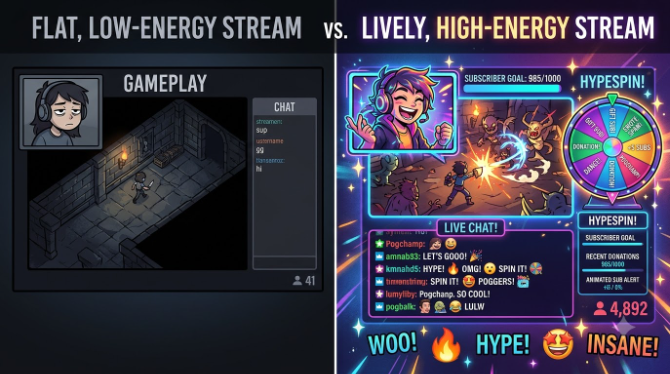
There's a familiar plateau that hits streamers and YouTubers once the production side is dialed in: the visuals are clean, the audio's balanced, the schedule is consistent — and yet the energy stalls. Viewers roughly know what's coming. That predictability, however comfortable it is to produce, is quietly working against retention.
A spin wheel is one of the few tools that breaks that pattern honestly. It introduces a result that neither the creator nor the audience scripted in advance, and unscripted results produce unscripted reactions — the kind that get clipped, shared, and rewatched. When a wheel lands on the exact outcome a creator was hoping to avoid, that ten-second moment is often worth more than an entire polished segment around it.
This is the working version of that idea: which wheel formats actually perform, how to source and curate segments, how to wire the wheel into your stream setup, and the specific ways creators accidentally flatten a format that should be one of their strongest.
Every format below can be built free at spinthewheelsonline.com — no account, no download, runs in any browser and drops straight into OBS as a browser source. If you want the mechanics behind how the tool actually generates its result — useful when a viewer questions fairness mid-stream — see what a spin the wheel tool is and how it works.
1. Why a Wheel Segment Outperforms Scripted Content
The wheel's core advantage over almost every other content device is simple: nobody involved controls the result. In a landscape where audiences are increasingly good at spotting manufactured spontaneity, something that's visibly, mechanically random stands out precisely because it can't be faked convincingly.
-
Nobody knows what happens next — including you Each spin is a small plot twist the creator experiences in real time alongside the audience. That shared uncertainty is doing a lot of the engagement work a well-produced segment usually has to fake.
-
Unscripted reactions travel further than scripted ones The clips that circulate best are genuine reactions to genuine surprises. A wheel landing on an outcome the creator visibly didn't want produces exactly that, without needing to be engineered.
-
It turns spectators into contributors Once viewer-submitted content is on the wheel, or chat is voting on segments, the audience has a stake in the outcome. That small sense of authorship is what turns a one-time viewer into someone who returns for the next spin.
-
It becomes a format, not a one-off A recurring wheel segment develops its own history — outcomes that never land, inside jokes about specific segments, running community bets. That accumulated context is what turns "a wheel" into "the wheel," a recognisable part of your channel.
-
It gives long sessions a rhythm Unstructured streams bleed viewers steadily because there's no reason to keep watching right now. A wheel creates small, regular events with their own build-up and payoff — enough to keep someone who was about to close the tab around for one more spin.
2. Six Wheel Formats Creators Actually Use
Most wheel content on streaming and video platforms falls into one of six recognisable formats. Knowing the mechanics of each makes it much easier to pick the one that actually fits your content and audience, instead of forcing a format that doesn't.
The Game Randomiser
The wheel sets gameplay conditions — character, difficulty, restriction, required item. The challenge is finishing the session under whatever the wheel imposed, not completing a separate dare. It works across nearly every genre and gets more intense as conditions compound.
The Subscriber Dare Wheel
Subscribers submit dares through comments, forms, or chat; the creator loads the strongest submissions and spins live. Because the audience wrote the content, every outcome carries a little more weight — and the submitter gets a moment of visible credit.
The Donation Milestone Wheel
Segments unlock as fundraising hits each threshold — the higher the tier, the bigger the outcome. This ties the wheel directly to the donation total, giving supporters a concrete reason to push past the next milestone.
The Audience Vote Wheel
Chat votes on what belongs on the wheel, or which segments get cut, while the creator curates for quality and safety. Strong for milestone streams — anniversaries, sub-count goals — where community ownership should feel front and centre.
The Elimination Wheel
Players, games, or outcomes compete across rounds, with the wheel deciding match-ups. As entries get eliminated, the wheel shrinks and each remaining spin carries more weight — a natural fit for multi-creator streams and tournament brackets.
The Mystery Item Wheel
Numbered products, foods, or unboxings are loaded onto the wheel, and the spin decides what's experienced next. The randomisation solves the predictability problem that flat, ordered unboxing videos run into.
3. Gaming Randomiser Wheels, in Detail
The gaming randomiser earns its versatility because it works across nearly every genre — the wheel doesn't bolt a dare onto the game, it changes the game itself. Here's how the strongest variants are built:
Character or loadout randomiser
Load every playable character, class, or loadout onto the wheel and spin at the start of each match or run. The restriction is immediate, visible, and holds for the whole session — building a running question ("can they actually win with this?") that tends to hold attention better than clean, skilled gameplay on its own.
Strongest fits: fighting games, battle royales, class-based RPGs, hero shooters, and deck-builders. The bigger the gap between the best and worst loadout in the game, the higher the stakes of each spin.
Restriction stack wheel
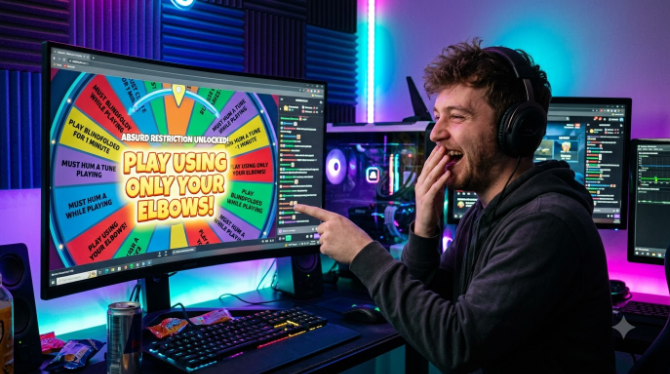
Each spin adds one more permanent restriction to the session, starting clean and stacking: "pistols only," then "no crouching," then "must taunt after every kill." By spin four or five the accumulated restrictions make the game nearly unplayable — which is precisely where this format peaks.
Game roulette — what plays next
Load 8–12 titles from your library, then spin at the end of each session or on a set timer to decide what plays next. This suits variety streamers well — it gives every game on the wheel a genuinely fair shot instead of the streamer defaulting to whatever's comfortable.
Tie channel points to specific segments on a game-roulette wheel. Viewers can spend points to "protect" a game they want played (temporarily pull it off the wheel) or "curse" one to appear twice. It gives the wheel a layer of audience agency that keeps chat active through the spin.
Speedrun category randomiser
Pair speedrunning with a category randomiser for some of the highest-tension wheel content available. Load Any%, 100%, Low%, Glitchless, and Random Item Only alongside difficulty and time-limit modifiers. Every spin produces a specific, demanding target with a visible finish line, which structures the whole session around one question: can this actually be completed?
4. Subscriber Dare and Challenge Wheels
The subscriber dare wheel is closely tied to viral YouTube content, and it holds up consistently because the mechanic is simple: the audience writes the challenge, the creator lives it. Because nothing was scripted, the creator's reaction is real.
Sourcing dares that actually work
-
Ask for something specific, not "dares" in general
"Submit a gaming challenge," "submit a food I have to eat," "submit something I can do in this room right now." A narrow prompt produces sharper submissions; an open call mostly returns noise.
-
Curate hard before anything goes on the wheel
Out of a couple hundred submissions, maybe 10–15 belong on the wheel. Ask: will this produce a real reaction, is it completable in the time you have, is it safe and appropriate, and does it differ from what's already on there.
-
State your completion rules before the first spin
"I'll attempt every dare once. If it's genuinely not possible, I take a penalty instead." Saying this upfront heads off any sense that you're quietly picking and choosing which outcomes to honour.
-
Credit the submitter out loud
"This one's from [username]" before you complete it. It gives the submitter a personal reason to clip and share the moment — and across a video with 10–15 dares, that adds up to real reach.
-
Turn on remove-after-spin
Each dare gets completed exactly once, and the shrinking wheel naturally raises the stakes as it goes. Save your most dramatic submission as a visible final segment so the audience is anticipating it the whole way through.
Sample dare wheel for gaming creators
5. Charity Milestone Wheels That Drive Donations
Charity wheels work differently from other creator formats because the wheel itself becomes the incentive — people donate to make it spin, not only to support the cause. That alignment between entertainment and fundraising mechanics is why milestone-based wheels consistently pull in more than a plain donation appeal on its own.
Building a tiered milestone structure
Arrange segments by donation tier, with each one tied to a specific threshold. As the total climbs past each milestone, a new spin unlocks. Keep the current total and the next target visible on screen at all times — donors need to see exactly how close they are to triggering the next spin.
| Donation Milestone | Wheel Outcome | Why It Works |
|---|---|---|
| £50 / $50 | 🎮 Play on max difficulty for 20 minutes | Low barrier, quick payoff — accessible at any donation size |
| £100 / $100 | 🎤 Sing a song chosen by chat | Viewer-directed and personal — chat nominates the track |
| £200 / $200 | 🍕 Eat a mystery food on camera | Visual, reactive, unpredictable — shareable by design |
| £500 / $500 | 🎭 Full costume for the next hour | High-commitment outcome that signals real appreciation to donors |
| £1,000 / $1,000 | 🏆 A stream extension announced live | Turns into a collective milestone for the whole community |
| Any amount | 🎡 Bonus spin on the dare wheel | An immediate small reward at any donation level, lowering the barrier to give |
Letting viewers steer the wheel directly
A stronger variation: let donors vote in real time on which segment gets added or removed. A donation adds the outcome someone most wants to see, or removes the one they'd rather skip. The wheel becomes a live document shaped by the audience, and it tends to spike chat activity every time it visibly changes — which keeps new viewers engaged and gives them a reason to donate too.
- Keep the current total and next milestone visible on screen throughout
- Announce each outcome before and after completing it, for viewers who just joined
- Execute every earned spin right away — banking spins deflates the momentum the donation created
- Hold one big outcome back for the final milestone and tell the audience it exists from the start
6. Letting the Audience Co-Author the Wheel
These formats hand part of the wheel over to the audience — through submissions, votes, or names placed directly on it. That shift turns the stream from something performed at viewers into something built with them.
Live Chat Controls the Segments
Run a 60-second vote, add the winning suggestion to the wheel on camera, then spin. The audience watches the wheel get built in real time — a mod helps filter suggestions so it stays manageable.
Spin to Pick a Viewer's Challenge
Subscribers submit a dare and their username together; both land on the wheel. The spin picks the dare and its author at once — public credit that pushes people to submit something worth landing on.
The Audience Builds the Wheel in Advance
Post a poll a day ahead letting followers pick 8–10 segments for the next stream's wheel. It creates pre-stream buzz and guarantees the wheel actually reflects what your audience wants to watch.
Viewers Spend Points to Influence Spins
Let points trigger a spin, add a temporary segment, weight an outcome, or remove one entirely. It builds a small economy around the wheel and turns point-spending into a direct signal of what viewers value.
Subscribers Compete via the Wheel
Load subscriber names and spin to pick who faces off each round — trivia, a quick game, whatever chat decides. Eliminated names come off the wheel. Scales cleanly from 8 to 64 entrants.
Spin to Select the Winner
Load every qualifying entry and spin live — seeing all entries loaded before the result makes the draw feel genuinely fair rather than opaque. Full breakdown: running fair online giveaways.
7. Formats That Work Especially Well on YouTube
YouTube videos have to hold attention across 10–20 minutes without live energy to lean on, so the wheel needs to earn its place in the edit differently than it does on stream. A few formats consistently deliver:
"I let the wheel decide my [X] for a week"
The wheel picks something to live with for seven full days — diet, workout plan, sleep schedule, outfit choices, gaming rotation — and the video documents what happens. The extended commitment, not the spin itself, is what carries the video: day-one uncertainty, mid-week adjustment, day-seven payoff. The wheel is just the spark.
Blind taste test or mystery unboxing wheel
Number a set of foods, products, or mystery boxes and spin to decide what gets opened next. This solves the predictability problem plain unboxing videos run into — when viewers can guess the order, the reveal loses its punch. A wheel makes every reveal genuinely uncertain.
Comment-sourced challenge compilation
Pin a comment asking for submissions, compile the best after a week, and film the completion video. This arrives with a built-in audience — everyone who submitted is likely to watch, and several will share it if their idea makes the cut.
Versus wheel — two creators, one wheel
Both creators' names go on the wheel; the spin decides who completes the next challenge, with the other's reaction as the secondary payoff. The dynamic between the two — watching a collaborator get landed on the worst outcome — is usually what carries collab content, not the challenge itself.
Titles that name the stakes outperform vague ones: "I Let a Wheel Decide My Diet for 7 Days (I Regret This)" does more work than "Wheel Challenge Video." Pair a visible wheel with a clear reaction expression in the thumbnail — the wheel is the promise, your face is the proof it was kept.
8. Wiring the Wheel Into OBS or Streamlabs
-
Build the wheel before you go live
Open spinthewheelsonline.com, enter every segment, match the colours to your stream branding, and run a full test spin. Never build a wheel live on camera for the first time — the setup drains the energy the wheel is meant to add.
-
Add it as a browser source
In OBS or Streamlabs, add a Browser Source and paste the wheel's URL. This captures the live wheel — spin animation and sound included — directly into your scene. Size the source to match its role: full-screen for wheel-focused segments, a smaller overlay for background use during gameplay.
-
Give it a dedicated scene
Build a scene with just the large wheel and your face cam, and switch to it for every spin. The clean transition signals to viewers that something distinct is about to happen and gives the wheel the visual space it deserves.
-
Route the wheel's audio into your mix
Make sure the browser source's audio is captured by OBS. The ticking deceleration sound carries a lot of the suspense — test the levels beforehand so it doesn't drown out your mic, but don't leave it muted either.
-
Bookmark the URL as a backup
The wheel's URL holds your full configuration. Save it as a browser bookmark and note it in your OBS scene notes — if the source breaks mid-stream, reloading takes under 30 seconds instead of losing the segment entirely.
-
For recorded video, film the spin as a separate take
If you're editing rather than streaming live, filming the spin on its own gives you full control over the pacing of the reveal and lets you capture your reaction separately for a cleaner cut. The result is still genuinely random either way.
9. Copy-Paste Segment Lists
Drop these directly into your wheel — each is built for a specific creator context.
🎮 Gaming challenge wheel (10 segments)
| Segment | The Challenge | Platform |
|---|---|---|
| 🔫 One weapon only | Complete the session with only the first weapon picked up — no swapping | Both |
| 😤 No deaths allowed | Instant restart on the first death — attempt ends there | Twitch |
| 🎭 Commentary character | Narrate gameplay in character for 15 minutes | Both |
| 💬 Chat chooses next action | Whatever chat votes for next gets executed in-game | Twitch |
| 🕰️ Speed mode | Beat the next level in under 3 minutes or take a penalty spin | Both |
| 🤝 Invite a viewer | A random subscriber joins the next multiplayer session | Twitch |
| 🙈 No HUD | Turn off the entire HUD for the next 10 minutes | Both |
| 🎵 Music swap | Play the rest of the session on a chat-submitted playlist | Twitch |
| 🔄 Genre switch | Spin the game roulette and play whatever it lands on for 30 minutes | Both |
| 🏆 Bonus spin | Earn a second spin on the bonus challenge wheel | Both |
🎬 YouTube dare wheel — "Let the audience decide" (10 segments)
| Segment | What Happens |
|---|---|
| 🍕 Mystery food | Order the most-reviewed item from a random local restaurant and eat it on camera |
| 💪 Live workout | Complete whatever workout the comments voted for, filmed in full |
| 📚 Read for an hour | Read a subscriber-chosen book and share one passage live |
| 🎨 Art commission | Draw a portrait of the most recent commenter in five minutes |
| 🌧️ Cold shower | Take a cold shower on camera — reaction footage included |
| 📞 Call an old friend | Call someone you haven't spoken to in over a year |
| 🎤 Karaoke | Sing a full song — top comment picks the track |
| 🧹 Cleaning speed run | Tidy one entire room as fast as possible, time-lapse included |
| 🌳 Outdoor challenge | Complete the next viewer-submitted dare outside, in public |
| 🔄 Re-spin | Spin again — the result must be doubled |
10. Where Creators Undercut Their Own Wheel Content
The wheel itself is simple. Where it goes wrong is almost always in how it's run.
- Loading outcomes you won't actually honour. The whole format rests on the audience believing the result is binding. The first time a creator re-spins a result they didn't like, or quietly "can't" do the outcome that landed, the wheel loses its meaning. Set the rules before spinning, then follow them without exception.
- Making every segment roughly equal. A wheel with genuine contrast — some outcomes the creator clearly wants, some they dread — is what produces real, visible reactions. A wheel where nothing much is at stake produces flat content. Every good wheel needs at least one segment that gets a nervous laugh as the wheel slows down near it.
- Spinning too fast to let outcomes land. Rushing through five spins in two minutes gives each result no room to breathe. Treat every outcome as its own complete moment — set it up, complete it, let the audience react — before moving to the next spin.
- Not showing the full wheel before the first spin. An audience that can see every possible outcome can calculate odds and anticipate results, which raises the stakes of every subsequent spin. A 30-second scroll through the segment list before spinning is worth the time.
- Only reaching for the wheel when content stalls. Using it purely as a filler tool trains the audience to see it as a last resort. It performs best as a scheduled feature with its own dedicated time, not something pulled out reactively when nothing else is happening.
- Forgetting to credit audience contributions. If a segment came from a viewer, reading their name before the outcome isn't just courtesy — it's the mechanism that turns individual viewers into people actively sharing your content with their own networks.
🎡 Ready to Build Your Challenge Wheel?
Free, instant, no account needed. Add it to OBS as a browser source or run it fullscreen — works for live streams, recorded videos, and everything in between.
Build Your Free Stream Wheel →