
- What a Wheel Actually Does For You
- 01 — Breaking a Writing Block
- 02 — Keeping a Workout Routine From Going Stale
- 03 — Closing Out Discretionary Spending Without Second-Guessing It
- 04 — Ending the "Where Do You Want to Eat" Loop
- 05 — Getting Past the Blank Page in Journalling
- 06 — Turning Flashcard Review Into an Actual Drill
- 07 — Splitting Chores Without Relitigating Them Weekly
- 08 — Unsticking a Brainstorm With a Forced Constraint
- 09 — Filling a Content Calendar in One Sitting
- 10 — Working a Task List Without Constantly Re-Ranking It
- The Familiar Uses, Done a Bit Better
- Frequently Asked Questions
What a Wheel Actually Does For You
A spin wheel doesn't come up with your options. That part's still on you. What it does is remove the last, most draining step of a decision: picking one thing out of a list of things you'd already be happy with.
Framed that way, the use cases go well beyond "giveaway" and "picking a name in class." Anywhere you've got a shortlist of acceptable options and a nagging reluctance to just commit, a wheel cuts the stalling short. Below are ten setups people use regularly, along with the specific entries worth loading onto each one. New to the tool itself? Our guide on what a spin the wheel tool is and how it works covers the basics first.
Only add options you'd genuinely accept. If half the entries are things you don't actually want, the wheel isn't saving you a decision — it's just stacking a coin flip on top of a decision you haven't made yet. Narrow the list first, then spin.
Writer's block usually isn't a shortage of ideas — it's too many half-formed ones with no obvious way to rank them. A wheel skips the ranking entirely. You spin, you get a starting point, and the choosing is over before it had a chance to slow you down.
Instead of one long list, build three small wheels: a setting wheel, a character-flaw wheel, and a conflict-type wheel. Spin all three and combine whatever lands. The combinations you wouldn't have chosen on purpose tend to be the ones worth writing toward, since you can't lean on your usual instincts to get there.
A fixed weekly split is easy to stick with for a month and easy to quietly abandon after that — usually right around the point where you can predict Wednesday's session before it happens. Predictability is efficient, but it's also where motivation tends to leak out.
Set up two wheels: one for workout type, one for duration. Spin both before you get changed, not after — deciding in advance removes the option to talk yourself out of it once you see the result. If "rest day" is one of the entries, treat it the same as any other outcome: the wheel picked it, so it counts.

This one is for a narrow, specific situation: you've already set a spending cap and shortlisted a few things that all fit inside it, but you keep circling back to compare them instead of buying anything. The hesitation usually isn't about the money anymore — it's about not wanting to feel like you picked the "wrong" option.
Since every entry already fits your budget, there's no wrong outcome. Load your options, set the cap once, and let the spin close it out. This only works if you were honest about the shortlist to begin with — don't add something you can't actually afford just to see what happens.
You know the exchange: "Where do you want to eat?" "I don't mind, you pick." Ten minutes pass and nobody's decided anything. A shared wheel — saved as a link both people can open — cuts that short, because the outcome is agreed to be binding before anyone spins.
The same setup scales up to travel. Shortlist destinations that are genuinely within budget and feasible for the time you've got, then spin. Because you already filtered for affordability, wherever it lands is a trip you can say yes to right away instead of one you have to talk yourself into. For more on why outsourcing low-stakes choices like this works, see our piece on the psychology behind random decision making.
"Write about your day" is a hard prompt to start from because it doesn't point anywhere in particular. A specific, unexpected prompt does — partly because it's specific, and partly because you didn't choose it yourself, so there's nothing to perform for.
Load a wheel with reflective prompts and spin before you write, not after you've already stalled for ten minutes. Some coaches and therapists use a version of this in sessions too: a topic wheel the client spins themselves, which avoids the sense that the practitioner is steering the conversation toward a particular subject.
Flashcard apps work well right up until you start recognizing the order of the deck instead of genuinely recalling each answer. A wheel has no order to memorize, which keeps the recall honest.
Load it with vocabulary, verb conjugations, or formulas. Set a hard time limit — five seconds is usually enough for a recall drill. If you miss it, the entry goes back on the wheel instead of being marked done, so the things you genuinely struggle with keep resurfacing instead of quietly disappearing into a "reviewed" pile.
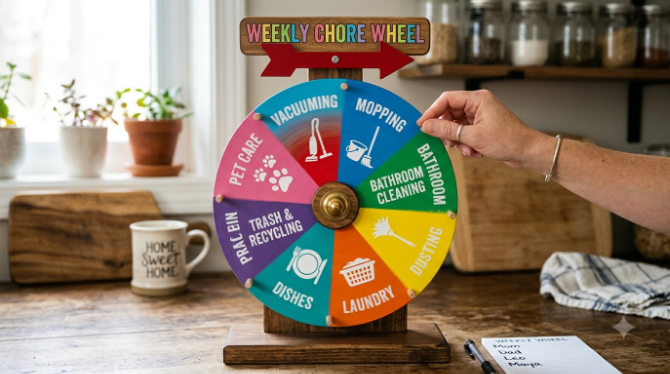
Most household task disagreements aren't really about the task — they're about who decided the assignment, and whether it felt fair at the time. A shared wheel removes the "who decided" question entirely, because nobody did. It landed where it landed.
Put each task on the wheel once per person doing chores that week, spin for who gets what, and treat the result as final. It won't feel perfectly even every single week, but it removes the recurring negotiation, and it tends to balance out on its own over a couple of months.
"Random input" is a recognized technique in design and product thinking: introduce a concept that has nothing to do with the problem, then force a connection to it. It works because stuck brainstorms are usually stuck in the same few well-worn directions, and a genuinely unrelated word breaks the pattern in a way that "just think differently" never manages to.
A wheel is the simplest way to pick that unrelated input on demand. Load it with plain nouns that have nothing to do with your business or project, spin whenever the room goes quiet, and give the team a fixed five minutes to connect the word to the problem at hand. Read more on how remote teams apply this in our guide on using spin the wheel for team decisions.
If you post regularly, the hard part usually isn't having topics — it's deciding, fresh, every single day, which topic and which format to use. That daily re-deciding is what actually drains people, not the content itself.
Do the deciding once a week instead. Build a format wheel (tutorial, quick take, behind the scenes, Q&A) and a topic wheel specific to your niche. Spin both, several times, in one sitting, and fill the week's calendar with the combinations. You're still choosing what to post — you're just doing it once instead of daily.
A lot of procrastination isn't avoiding work at all — it's avoiding the decision of which piece of work to start with, especially when everything on the list feels equally urgent. Constantly reordering a to-do list can feel productive while accomplishing nothing.
Add the day's tasks to a wheel and spin at the start of each focus block. Work on whatever it lands on for a set stretch — 25 minutes is a common length — then spin again for the next block. It won't always give you the "optimal" order, but it reliably beats the time lost deciding what optimal even means. If you catch yourself reorganizing the list instead of working, that's the moment to spin instead. Our Yes or No wheel is a lighter companion for the smaller "now or later" calls that come up throughout the day.
In every setup above, the thinking happened before the spin — the shortlist, the budget, the acceptable options. The wheel doesn't decide for you; it ends the loop of re-deciding something you'd already settled. That's the actual value of a random wheel: not luck, but a clean way to commit.
The Familiar Uses, Done a Bit Better
Giveaways, classrooms, and game nights are the obvious uses for a reason — they work. Most people using a wheel for these still get less out of it than they could, though, so a few upgrades worth knowing about:
🏫 Classrooms
Beyond picking names — group formation, topic assignment, and exit-ticket questions. Full setups in our teacher's guide.
🎁 Giveaways
A visible draw builds more audience trust than a hidden picker. Walkthrough in our giveaway winner guide.
🎉 Game Nights
Party and family activity setups in our game night guide.
💼 Work & Teams
Task assignment and icebreakers for remote teams, covered in our team building guide.
🎡 Build One of These Right Now
Pick a setup above, add your own entries, and spin. Free, no account, works on any device.
Open Spin the Wheel — Free →Frequently Asked Questions
Can I keep separate wheels for different uses?
How is a spin wheel different from a Yes or No wheel?
How many entries should I put on a wheel?
Is the outcome actually fair across repeated spins?
Do I need an account to use these setups?
- A spin wheel is useful anywhere you have a pre-approved shortlist and need to stop stalling on the choice.
- Filter your options honestly before you spin — the wheel only removes the last step, not the thinking.
- Everyday, personal uses (writing, habits, budgeting, tasks) often get more value from a wheel than the well-known ones.
- Save separate wheels as bookmarked links so each setup is ready in seconds.