- The Quick Take
- "True" Randomness vs. Computer Randomness
- What Happens the Instant You Click Spin
- Can Timing a Click Change the Outcome?
- Where a Draw Can Actually Be Skewed
- Stepping It Up: Cryptographic-Grade Randomness
- Spinning by Hand vs. Spinning Onscreen
- Six Things People Get Wrong About the Wheel
- Building a Draw People Can Trust
- Frequently Asked Questions
Every so often, a class asks why the wheel "always" lands on the same classmate. A streamer's chat accuses them of tapping the button at just the right moment. A raffle winner gets a message asking whether the draw was really fair. Underneath all of these is one question: is a digital spin wheel actually random, or does something behind the scenes decide who wins?
The honest answer takes a bit of unpacking, because "random" means something more specific to a computer than it does in everyday conversation. Below is the full picture — how the number behind every spin gets made, where a draw can genuinely be manipulated (and where it can't), and what actually makes a wheel trustworthy in practice.
The Quick Take
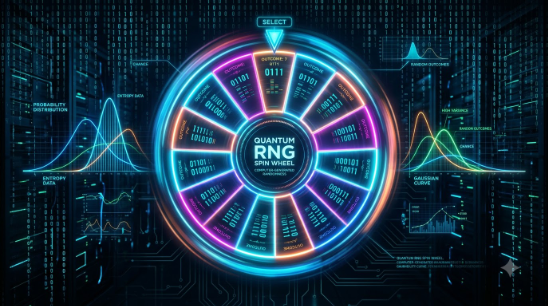
A well-built digital spin wheel decides its outcome using a random number generator baked into the browser — an algorithm that produces values no person can foresee or steer. Clicking earlier or later, spinning harder, or watching where a segment sits on the dial changes nothing about where the wheel settles. For classroom picks, team decisions, live-stream challenges, and everyday raffles, that's as close to random as anyone needs. The parts worth understanding are covered section by section below — including the one place a draw actually can be unfair.
"True" Randomness vs. Computer Randomness
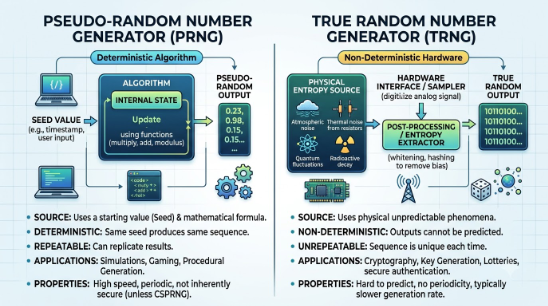
Before judging whether a spin wheel is random, it's worth separating two ideas that get lumped together: randomness that comes from physics, and randomness that comes from a formula. They're not the same thing, and the difference explains a lot about how software actually works.
Sourced From the Real World
Comes from processes nobody can predict even in theory — radioactive decay, atmospheric static, the thermal jitter inside a chip. Because the underlying physics is genuinely unpredictable, this is the gold standard, and it's what specialized hardware random-number devices tap into.
A Formula With a Moving Target
A pseudo-random number generator is a math formula that starts from a "seed" and spins out a long stream of numbers that look and behave like random data. Feed it the same seed twice and you'd get the same stream — but the seed itself is drawn from things like the exact nanosecond of the click, so in practice no two spins ever share one. This is what runs behind almost every spin wheel.
Randomness Built to Resist Attackers
A cryptographically secure generator, reachable in any modern
browser through crypto.getRandomValues(), is
engineered so that even someone who has seen thousands of past
outputs still can't guess the next one. Overkill for a classroom
pick; the right tool for a draw with real money on the line.
Layers of Everyday Chaos
A generator is only as unpredictable as its seed. Browsers pull from several moving sources at once — timestamps measured in billionths of a second, hardware counters, and low-level system noise — and combine them into a starting value nobody outside the machine could reconstruct.
For a spin wheel used at school, at work, on stream, or in a giveaway, the difference between physics-grade randomness and algorithm-grade randomness rarely matters in practice. A generator seeded with nanosecond timing is unpredictable to any person and to any realistic attack. The question worth asking isn't "is this philosophically perfect randomness?" — it's "can anyone actually predict or steer where this lands?" For a properly built wheel, the answer is no.
What Happens the Instant You Click Spin
Understanding the sequence behind a single spin makes the timing and rigging questions much easier to answer with confidence.
-
A number is drawn the moment the spin fires
As soon as the spin is triggered, the browser's built-in generator produces a decimal value between 0 and 1, built from a seed no outside observer can see — a mix of precise timing data and low-level system state that shifts constantly. This single number is what everything else depends on.
-
That number picks a segment
The circle is divided into slices sized to match each entry's weight — equal by default. Multiply the random value by 360° and you get an angle, and that angle falls inside exactly one slice. Ten equal entries means each one owns 36° and a one-in-ten shot; thirty equal entries means 12° apiece and a one-in-thirty shot.
-
The spin animation plays out an already-settled result
This is the part most people don't realize: the winner is decided before the wheel even starts moving. The spinning graphic — speeding up, slowing down, the little ticking sound — is a performance of a result the code already computed. Nothing that happens on screen after the click changes that number.
-
The wheel settles exactly where it was always going to
The animation is timed so the wheel glides to a stop on the segment chosen in step one. The suspense of watching it slow down is genuine entertainment — but it's the reveal of a fixed outcome, not the moment the outcome gets decided.
Can Timing a Click Change the Outcome?
This is the single most common misconception people bring to a spin wheel, so it's worth tackling head-on. The intuition feels reasonable — "if I time my click right, I can land where I want" — but it doesn't match how the code works.
The result comes from a random value tied to the exact nanosecond of the click, combined with hardware-level entropy. Whatever segment happens to be sitting at the top of the wheel visually has no connection at all to that calculation — it's purely a display element, not an input the randomness reads.
Predicting a spin in advance would require knowing the exact internal seed of the browser's generator at that instant — which means reading nanosecond-level hardware timing from several internal sources at once. That's not something a person can do, and it's not a realistic computational attack against the generators mainstream browsers actually ship.
Where a Draw Can Actually Be Skewed
Here's the balanced answer: the spin can't be rigged — once it starts, nobody, including the person running it, can nudge where it lands. But the setup before the spin is entirely in the operator's hands, and that's where real unfairness can sneak in.
An operator could load the wheel with uneven segment sizes, handing one entry more arc space than the rest — or add a favored name to the wheel several times while everyone else gets one slot. If one person's name appears ten times against everyone else's single entry, that person has ten times the odds, and the spin itself will still look perfectly random even though the setup wasn't fair.
The fix is simple: show the full list of entries before spinning. When every participant can see exactly what's loaded on the wheel — and count that no name shows up more than agreed — the setup becomes just as visible as the spin itself. That's why good giveaway practice means displaying the wheel's contents publicly before the first click, not just announcing the winner afterward.
Three habits make a spin-wheel draw hard to dispute: show the full entry list on screen before spinning so anyone can count entries, have someone other than the organizer click the button, and keep a screen recording of the whole thing. See our companion guide on running a fair online giveaway for the full walkthrough.
Stepping It Up: Cryptographic-Grade Randomness
For nearly every use of a spin wheel, the browser's standard
Math.random() generator is more than strong enough — no
person and no everyday attack can predict it. But for higher-stakes
situations — large cash prizes, regulated competitions, anything
gambling-adjacent — there's a stronger option available.
The crypto.getRandomValues() API gives access to a
cryptographically secure generator. The practical difference: a
standard generator is safe against a human trying to guess it; a
cryptographic one is safe against a computer trying to calculate it,
even with access to thousands of past results. Its defining property
is that its output can't be told apart from genuine randomness, even
by an adversary with real computing power behind them.
| Method | Guessable by a person? | Guessable by a computer? | Best suited for |
|---|---|---|---|
| 🎲 Standard generator (Math.random) | ✓ No | ⚠ Only in theory, with full internal-state access | Classrooms, giveaways, team decisions, everyday games |
| 🔒 Cryptographic generator (CSPRNG) | ✓ No | ✓ No — computationally infeasible | High-value draws, regulated competitions, financial contexts |
| 🌡️ Hardware entropy source | ✓ No | ✓ No — physically impossible | Security keys and cryptographic infrastructure |
| 🪄 Physical spinning wheel | ⚠ Partly, with practice and physics | ⚠ Predictable with camera tracking + a physics model | Casual, low-stakes use — actually less random than digital |
| 🎴 Hat draw / shuffled cards | ⚠ Open to sleight of hand | N/A | Casual settings where the process itself isn't watched closely |
Spinning by Hand vs. Spinning Onscreen
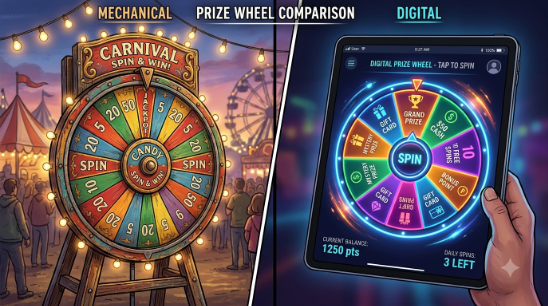
This one surprises most people. A physical spinning wheel is actually less random than a properly built digital one, for reasons that come straight from basic physics.
A physical wheel's stopping point is a product of how hard it was spun and how friction slows it down — both governed by ordinary mechanics. Measure the initial spin force precisely enough and, in principle, the stopping point becomes predictable. In casual use, natural variation in how hard people spin makes it feel unpredictable — but the underlying process is deterministic, not random.
There's also a practical angle: a physical wheel can be nudged by a practiced operator through consistent spin technique, starting position, or a slightly worn pivot. A digital wheel has no equivalent — the spin button is a single trigger with no "technique" that could influence the number generated behind it.
Six Things People Get Wrong About the Wheel
"The same name keeps winning, so it must be rigged"
People badly underestimate how often streaks happen naturally. On a 10-segment wheel, the same segment landing three times in a row has roughly a 1-in-100 chance per session — unlikely, but far from impossible. That's ordinary variation, not bias.
Clusters are what randomness looks like
A perfectly even spread across ten spins would actually be a red flag — it would suggest the system was quietly correcting itself. Lumpy short-run results are a sign of genuine randomness, not evidence against it.
"Clicking faster or slower changes the result"
The outcome comes from a nanosecond-precision timestamp and several hardware entropy sources the instant the click fires. Human click-timing variation, measured in whole milliseconds, can't meaningfully shift a seed built from inputs that change far faster than any person can control.
The click starts the process, it doesn't shape it
Clicking tells the code "generate a number now" — it doesn't influence what that number turns out to be. The randomness comes from the machine's internal state at that instant, not from anything about how the click was performed.
"Whatever's at the top when you click has better odds"
The wheel's visual position at the moment of the click has zero mechanical link to the number generation happening behind it. The display could be showing anything — the result comes purely from the generator's output, which never looks at what's on screen.
Visuals and the random draw run on separate tracks
The spinning animation is purely for show. The generator does its work independently of anything rendered on screen — even pausing the animation mid-spin wouldn't change how the number was produced.
Building a Draw People Can Trust
Whether anything can be "truly" random in the deepest philosophical sense is still debated in some corners of physics. But for practical, everyday spin-wheel use — who answers the next question in class, who takes notes this week, who wins the giveaway — the question that actually matters isn't philosophical. It's whether anyone can predict, bias, or steer the outcome. For a properly implemented digital wheel, they can't.
- Equal segments: Every entry gets equal space on the wheel unless weighting was agreed on and made visible
- Visible entry list: Everyone involved can see every name loaded on the wheel before it spins
- No re-spinning: The result stands — no re-rolling until a preferred name comes up
- A neutral hand on the button: For anything high-stakes, someone without a stake in the outcome triggers the spin
- A record of the draw: Screen-recording the entry list, the spin, and the result makes the whole process reviewable afterward
A wheel run this way holds up as a genuinely fair way to choose — arguably more so than lolly sticks, a hat draw, or a coin flip, because it's harder to quietly manipulate and easier to document after the fact.
"Is it random?" is often really a stand-in for "can I trust this?" The answer is yes — not because the math is philosophically flawless, but because a well-built digital wheel is practically impossible to manipulate and far more transparent than any physical alternative. For more on how it stacks up against other selection methods, see our guide to spin wheel vs. other random pickers.
🎡 Try the Wheel Yourself
Genuinely random, fully transparent, and free. No account, no download — works in any browser.
Open the Free Spin Wheel →