- Why a Spin Wheel Beats a Hat Full of Tickets
- Three Things to Decide Before You Build the Wheel
- Setting Up Your Raffle Wheel, Step by Step
- Handling Multi-Ticket and Weighted Entries
- Running the Live Draw Like an Event
- Managing More Than One Prize
- Six Raffle Formats Schools Actually Use
- Lessons From Schools That Do This Every Term
- Frequently Asked Questions
- Conclusion
There's a particular kind of grumbling that follows almost every school raffle: was the hat shuffled properly? Did the same three families always seem to win? Is there any record of who actually entered? Most of the time nothing dishonest happened — but a draw nobody could watch closely enough to trust leaves room for doubt, and doubt is corrosive to something that's supposed to be a fun, community moment.
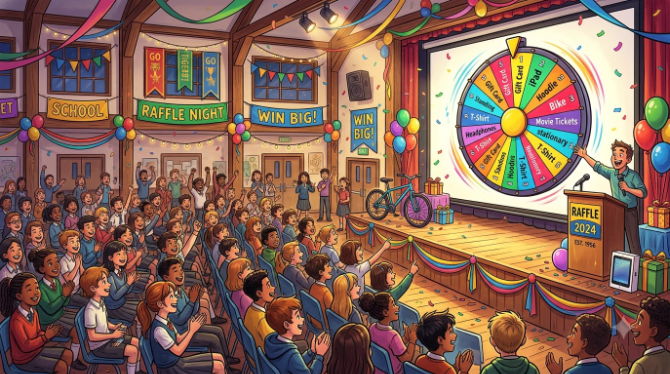
A free spin wheel, projected on a screen for everyone to see, removes that doubt almost entirely. It's visible from every seat in the hall. It's provably random rather than "probably fine." It builds genuine suspense as it slows down. And it costs nothing to run — no software, no printing, no login.
This guide walks through the whole process — planning, setup, the live draw, and handling multiple prizes — so your next raffle is both fun to watch and impossible to argue with.
If you haven't used one before, our quick guide to spin wheel tools covers the basics of setup and randomness in under five minutes — worth a skim before your first school event.
1. Why a Spin Wheel Beats a Hat Full of Tickets
A hat draw has been the default for decades, but it has real, practical limits: only the person holding the hat can see the tickets get mixed, most of the room is too far away to actually watch anything happen, and there's no way to replay the moment if anyone questions it later.
A spin wheel fixes each of those at once:
-
The whole room can see itProject it on a hall screen and every student watches the same draw happen in real time — nobody's craning their neck to see a hand in a bag.
-
Nobody can tilt the resultThe outcome is set by the browser the instant the spin starts, before the animation even plays — the person clicking has no way to influence where it lands. More on the mechanics in is a spin wheel truly random.
-
It's genuinely exciting to watchThe slowing tick as the wheel decelerates builds real suspense — a quiet, held-breath moment a hand reaching into a hat just doesn't produce.
-
You can record it and prove itScreen-record the draw and you've got a permanent record anyone can watch afterward — parents who missed it, students who want a replay, or anyone who has a question later.
-
Costs nothing to runNo printed tickets, no box, no bag. Just a browser and your list of entrants — every pound the raffle raises stays in the fundraiser.
2. Three Things to Decide Before You Build the Wheel
Get these settled first and the setup itself takes minutes.
Who's entering, and how?
Decide whether it's open to the whole school, one year group, or families too. Then decide how entries are earned — bought tickets, merit points, event participation, or simply being present. This decides how you'll build the wheel.
What are the prizes, and in what order?
List prizes from smallest to biggest. Save the headline prize for last — it's what keeps the room's attention through every earlier spin.
Does everyone get equal odds?
A simple draw gives everyone one entry. A fundraising raffle with multiple tickets per family needs weighted entries instead — covered in Section 4.
A raffle that involves selling tickets can fall under your country's gambling or lottery regulations — in the UK, for instance, that's typically the Gambling Act 2005. Check with your school's administration before running a paid-ticket raffle. This guide covers the draw mechanism, not local compliance.
3. Setting Up Your Raffle Wheel, Step by Step
-
Open the wheel on your draw device
Go to spinthewheelsonline.com on whichever laptop will be connected to the projector on draw day — building and drawing on the same device saves you rebuilding it later.
-
Add every entrant's name or ticket number
Type or paste each name into the wheel. For numbered raffles, enter ticket numbers instead — the wheel works the same either way.
- Small draws: type names directly
- Larger draws: paste in bulk from a spreadsheet column
- Double-check the count matches your confirmed entrant list
-
Turn on "remove after spin" for multiple prizes
This drops each winner off the wheel automatically once they're drawn, so nobody can win twice in the same session.
-
Bookmark or save the wheel URL
This preserves your whole setup — names, settings, everything — so it reloads exactly as built, with nothing to re-enter on the day.
-
Test the projector display beforehand
Check fullscreen mode looks right on your hall screen, and confirm the ticking sound is audible — it's a big part of what makes the draw feel exciting. Do this the day before, not five minutes before.
-
Set up screen recording (worth doing)
Windows: Win + G. Mac: Cmd + Shift + 5. Start recording before you open the wheel so the full entry list is captured too.
4. Handling Multi-Ticket and Weighted Entries
When families buy more than one ticket, each one should count as an equal extra chance. The fix is simple: enter a name once for every ticket they hold.
The Ahmed family bought 5 tickets, the Ortiz family bought 1. Add "Ahmed" five times and "Ortiz" once. The odds now match the tickets sold exactly — the wheel's randomness handles the rest.
Doing this at scale
For a large raffle, it's faster to enter ticket numbers instead of names. If you sold tickets 001–300, add all 300 numbers to the wheel, then match the winning number to your sales ledger. No repeated typing needed.
| Raffle Type | Wheel Entry Method | Best For |
|---|---|---|
| 🎯 Equal chance | One name per student | Classroom draws, attendance prizes, merit draws |
| 🎟️ Multi-ticket, named | Name repeated per ticket bought | Small named-ticket fundraisers |
| 🔢 Numbered tickets | All sold numbers entered | Fetes, large fundraising raffles |
| ⭐ Merit-weighted | Name repeated per point earned | End-of-term reward draws |
5. Running the Live Draw Like an Event
-
Show the full entry list first
Scroll through the wheel before the first spin so everyone can see all entries are there. State the total count out loud for numbered raffles.
-
Let a student or parent press spin
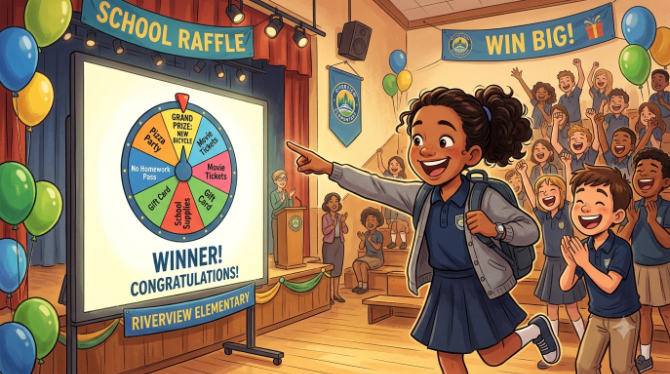
Someone outside the organising team clicking the button removes any perception that the operator could be timing the result — and gives that person a nice moment in front of their peers.
-
Don't talk over the ticking
The slowing wheel is doing the engagement work on its own. Let the room sit with it.
-
Announce the winner and give them a moment
Read the name or number clearly, repeat it, and pause. Don't rush straight to the next spin.
-
Show the removal, then move on
With remove-after-spin on, point out that the winning name has disappeared before spinning again — visible proof no one wins twice.
6. Managing More Than One Prize
Option A: One wheel, several spins (simplest)
Turn on remove-after-spin and draw smallest prize to biggest from the same wheel. The pool shrinks with each spin, which naturally raises the tension as you approach the final prize.
Option B: A separate wheel per prize group
Useful if different year groups have different prize pools — build and bookmark a wheel for each so you can switch between them without rebuilding anything mid-event.
Option C: Name wheel + prize wheel combo
Spin one wheel to pick a student, then a second to assign them a random prize from a roughly equal set. Works well at classroom level — see our guide to creative uses of a random wheel for more on this format.
7. Six Raffle Formats Schools Actually Use
Reading Challenge Draw
One entry per book read during a reading month — draw held in assembly, entries visibly tied to effort.
Merit Point Term Draw
Every house or merit point earned that term becomes an entry — a motivating milestone the whole term builds toward.
Summer Fete Grand Draw
Numbered tickets sold all day, drawn live on stage at closing — no personal data needed, just ticket numbers.
Sports Day Participation Draw
Every participant gets one entry regardless of placing — rewards showing up, not just winning.
Competition "Highly Commended" Draw
A separate wheel among non-winning entries gives everyone who entered a genuine second shot.
Weekly Classroom Reward Draw
Replaces a teacher's manual pick with a wheel among anyone who earned a commendation that week — fair, fast, no favouritism disputes.
8. Lessons From Schools That Do This Every Term
- Verify your entry count before the draw. Count confirmed entrants, count wheel entries, make sure they match, and say the total out loud before spinning.
- Use first name + initial for anything recorded or shared. "Emma T." rather than a full name protects privacy in a video or social post while staying identifiable in the room.
- Only enter ticket numbers that were actually sold. Not your full print run — keep a sold-ticket ledger to check the winning number against.
- Have an independent colleague check the entry list. A two-minute check against the original register heads off any later dispute.
- Tell students the rules in advance. A quick assembly mention the week before builds anticipation and sets expectations.
- Record every draw as a habit. "Here's the video" beats "trust us" every time a question comes up later.
- Build and test the wheel the night before. Not five minutes before assembly — technical hiccups in front of 300 students are avoidable.
🎡 Ready to Build Your Raffle Wheel?
Set it up in under two minutes — no account, no cost, no download. Works on any laptop, tablet, or classroom screen.
Open Free Wheel Spinner →9. Frequently Asked Questions
10. Conclusion
A school raffle should be simple to run and fun to watch — and the draw itself is where that either holds together or falls apart. A projected spin wheel makes the process visible to everyone, keeps the result provably random, and leaves you with a recording if anyone ever asks how it went. The hat-and-tickets method got schools this far, but once a hall full of students has watched a wheel tick down to a winner, it's hard to go back.
Build your wheel at spinthewheelsonline.com before your next event — it takes two minutes, costs nothing, and makes draw day something students actually look forward to.
- Entries verified against your confirmed entrant list
- "Remove after spin" enabled for multi-prize draws
- Wheel bookmarked and loaded on the draw device
- Projector display tested, fullscreen confirmed
- Audio routed to hall speakers
- Screen recording ready before the wheel opens
- Independent staff member has checked the entry list
- Student or parent lined up to click spin
- Prizes ordered smallest to biggest