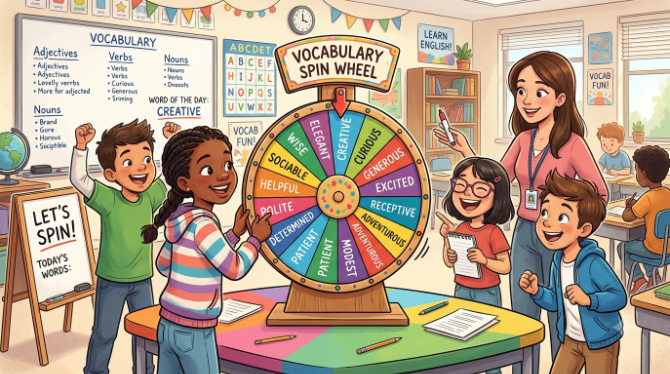
- Why a Spin Wheel Works for Language Learning
- Vocabulary Building Wheels
- Verb Conjugation & Grammar Roulette
- Conversation Starter Wheels
- Pronunciation & Listening Practice
- Wheel Ideas by Proficiency Level
- Ideas for Self-Learners
- How to Set Up Your Language Wheel
- Frequently Asked Questions
- Final Thoughts
Most vocabulary practice fails for a boring reason: the learner knows what's coming. A worksheet with twenty words in order, a flashcard deck that always starts the same way, a "go around the room" question round — the brain can coast through all of these on recognition alone, without ever doing the harder work of pulling a word or a verb form out of memory under a bit of pressure.
A spin wheel breaks that. Nobody — including the teacher — knows what's coming next. That small dose of unpredictability is enough to shift a drill from passive to active, and it works whether you're running a classroom of thirty or quizzing yourself alone at a kitchen table.
This guide collects 20+ specific spin wheel setups for language learning — vocabulary, verbs, pronunciation, and conversation — with exact entries you can copy in, ideas sorted by proficiency level, and a section for self-learners studying without a classroom at all. If you've never built a wheel before, our quick guide to what a spin the wheel tool is covers the basics in under two minutes.
🧠Why a Spin Wheel Works for Language Learning
Language acquisition depends heavily on retrieval practice — actively pulling a word, a form, or a structure out of memory, rather than just recognising it when you see it. That's the gap between "I understand this when I read it" and "I can actually use this when I need it," and it's the gap most self-study routines never close.
A wheel forces retrieval because the learner genuinely doesn't know what's about to land. There's no way to pre-load an answer the way you can when you know question six is always about colours. For a deeper look at why randomized selection changes how people engage with a task, see the psychology behind random decision making.
There's a group-dynamics angle too. When a wheel could land on anyone, everyone in the room stays quietly engaged, mentally rehearsing an answer, because it might be their turn next. That's a different kind of attention than passively waiting through a fixed order — and it's one reason teachers who try a vocabulary wheel for a single lesson often keep using it for the rest of term.
📚Vocabulary Building Wheels
Vocabulary is where repetition gets tedious fastest — and where a wheel earns its keep fastest too. Six setups to try:
Definition on the Spot
Load target words. Whoever the spin lands on defines the word from memory, no notes.
🎡 Example entries:Translate Under Pressure
Load words in the target language. The player has five seconds to give the translation.
🎡 Example entries (Spanish → English):Use It in a Sentence
The wheel picks a word; the player builds one original, correct sentence with it in 30 seconds.
🎡 Level up:Category Blast
Load semantic categories. The wheel picks one; the group has 60 seconds to name as many items as possible.
🎡 Example entries:Synonym Swap
Load common words; the player gives a synonym or antonym in the same language.
🎡 Example entries:Word of the Day Picker
Pre-load a week's vocabulary list. Spin each morning to pick that day's focus word.
🎡 Works well for:🔀Verb Conjugation & Grammar Roulette
Conjugation punishes rote memorisation the moment it's tested out of sequence — which is exactly the situation a wheel creates on purpose. Four setups worth building:
Tense Roulette
Load tenses onto the wheel. Announce a verb, spin, and the player conjugates it in whatever tense lands.
🎡 Example entries (French):Subject + Verb Double Spin
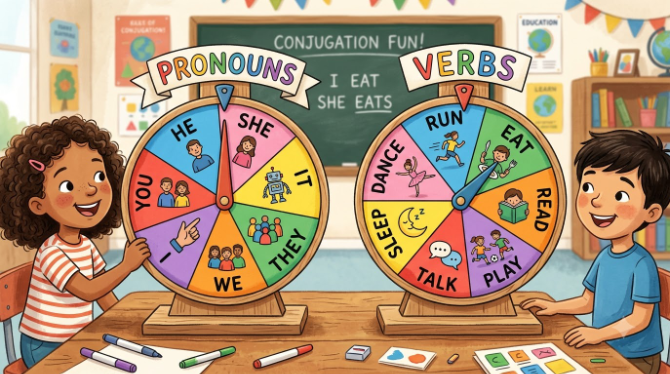
Build two wheels — subjects on one, verbs on the other. Spin both; the player conjugates on the fly.
🎡 Wheel A (subjects):Irregular Verb Spotlight
Load the most common irregular verbs. Spin picks one; the player gives all forms in a chosen tense from memory.
🎡 Example entries (Spanish):Structure Roulette
Load a grammar structure; the player builds two original example sentences with it.
🎡 Example entries (German):Classes juggling more than one target language can add a "language roulette" wheel that decides which language the conjugation has to be in — a genuinely difficult but effective way to keep advanced groups on their toes.
💬Conversation Starter Wheels
Speaking is the skill most learners struggle with longest, and it's rarely a vocabulary problem — it's that real conversation is unscripted, and most classroom speaking practice isn't. A conversation wheel is a safe way to practice the unscripted part.
Topic Spinner
Load topics; the player speaks for 60–90 seconds on whatever lands, no prep, no notes.
🎡 Example entries:Opinion Roulette
Load thought-provoking questions. The player answers with an opinion and at least one reason — good debate prep.
🎡 Example entries:Role-Play Scenario Selector
Load classic exam-style scenarios; two students spin together and improvise a two-minute dialogue on whatever lands.
🎡 Example entries:Constraint Wheel
Instead of topics, load constraints — "no fillers," "speak only in questions" — to add playful difficulty to any pair conversation.
🎡 Example entries:🎙️Pronunciation & Listening Practice
Pronunciation tends to get squeezed out of language curricula, but it's one of the most practically important skills for actually being understood. A wheel gives it a low-stakes, slightly gamified format instead of an isolated drill nobody enjoys.
Minimal Pairs Roulette
Load word pairs that differ by a single sound. The wheel picks one; the player pronounces it and uses it in context.
🎡 Example entries (English learners):Tongue Twister Spinner
Load short, phonetically tricky phrases. The player says it clearly three times, faster each time.
🎡 Good for:Listen & Summarise Wheel
Load media types. The wheel picks one; play a short clip of that type, then summarise it in the target language.
🎡 Example entries:Stress Pattern Challenge
Load multi-syllable words; the player identifies and demonstrates the stress pattern, clapping the stressed syllable.
🎡 Pairs well with:📊Wheel Ideas by Proficiency Level
The randomisation works the same at every level — the content shouldn't. Here's a breakdown by CEFR band:
Keep entries simple and high-frequency — the goal is automaticity with core vocabulary, not complexity.
- Numbers wheel: Spin picks a number; the student says it aloud.
- Colours and shapes: Spin picks a category; the student names five items in it.
- Greetings roulette: Spin picks a time or situation; the student gives the right greeting.
- Simple question wheel: Spin picks a question word; the student forms a basic question with it.
Intermediate learners need to bridge knowing a grammar rule and applying it spontaneously — a wheel is well suited to exactly that gap.
- Tense conversion: Say a sentence in the present; the student converts it when a tense lands.
- Phrasal verb roulette: Spin picks a phrasal verb; the student explains and illustrates it.
- Compare and contrast: Spin picks a topic; the student compares two things using comparative structures.
- Connective wheel: Spin picks a connective; the student builds a sentence around it.
Advanced learners plateau when they stop being challenged. Push for precision and nuance, not just accuracy.
- Register shift: Spin picks a register (formal, colloquial, academic); the student rewrites a sentence in it.
- Idiom wheel: Spin picks an idiom; the student explains it and gives a plausible context.
- False friends challenge: Spin picks a word that looks similar across languages but isn't; the student explains the trap.
- Discourse marker wheel: Spin picks an advanced connective or hedge; the student builds a mini-argument with it.
🏠Spin Wheel Ideas for Self-Learners
You don't need a classroom for this to be useful. Solo learners — using apps, textbooks, or a tutor — can use a wheel to add structure and variety to independent study that would otherwise drift toward the same one or two easy habits.
Study Method Selector
Unsure how to spend your next 30 minutes? Build a wheel of study methods and let it decide — removes the decision fatigue that often ends in "just one more video."
🎡 Example entries:Writing Prompt Wheel
Load journalling prompts; spin picks your topic for a 10-minute free-write in the target language — no editing, just output.
🎡 Example entries:More creative, non-obvious ways to use a wheel — including for personal projects beyond language study — are covered in 10 best uses of a random wheel spinner you haven't thought of.
⚙️How to Set Up Your Language Learning Wheel
- Open spinthewheelsonline.com in any browser — no download or sign-up.
- Clear the default entries and paste in your vocabulary, tenses, or topics.
- Turn on "remove after spin" if you want full coverage before anything repeats.
- Bookmark the link — the wheel's content lives in the URL, ready instantly next session.
- Project it for a classroom, or run it from your own device for 1:1 and solo study.
For classroom-specific setup — interactive whiteboards, managing "remove after spin" across multiple classes — see the full teacher's guide to using spin the wheel in the classroom. For activities needing random student selection alongside your content wheel, a name picker wheel running in a second tab covers that.
🔗 More Guides You'll Find Useful
❓Frequently Asked Questions
Can I use the spin wheel for any language, not just European ones?
Yes. The wheel displays whatever text you type in — Arabic, Japanese, Korean, Mandarin, Hindi, or anything else — as long as your device supports the script, which modern devices do.
Is the spin wheel actually random, or will it repeat the same entries?
It's genuinely random — every entry has an equal chance on each spin. To stop repeats within one session, turn on "remove after spin." See is a digital spin wheel truly random? for the full explanation.
How many entries can I add to a language wheel?
No hard limit — a full unit's vocabulary works fine. For revision sessions, many teachers prefer 15–20 items per wheel to keep pace up, using "remove after spin" for full coverage.
Can I use it for one-to-one tutoring sessions?
Yes — share your screen so the student sees it spin live. Because the wheel picks the topic rather than the tutor, sessions tend to feel less like being tested and more like a game.
What's the best way to use it for exam preparation?
Build wheels directly from your syllabus vocabulary and grammar structures, and use "remove after spin" for systematic coverage. For speaking exams, load the wheel with the actual task types that appear on the paper so practice mirrors the real format. See how to use a spin wheel for classroom activities for the full setup.
Can students use it at home for independent study?
Yes — share the saved link to a pre-built wheel and students can self-quiz independently, including on mobile. Some teachers set a weekly "homework wheel" that picks the independent practice activity for the week.
✅ Key Takeaways
- A spin wheel forces active retrieval instead of passive recognition — the difference that actually consolidates vocabulary and grammar.
- Vocabulary wheels work best with "remove after spin" for full coverage before repeats.
- Conjugation wheels gain power from double-spinning — one wheel for the verb, one for the subject or tense.
- Conversation wheels simulate the unpredictability of real speech, which is what builds actual fluency.
- The same tool scales from a classroom of thirty to a single self-learner — free, at spinthewheelsonline.com.
🏁Final Thoughts
Progress in a language mostly comes down to how much active, varied practice a learner actually gets — not the quality of any one resource. A spin wheel doesn't replace a textbook or a tutor, but it makes the practice you already have more frequent, more active, and easier to keep up over months rather than weeks.
Build one wheel today — vocabulary, verbs, or conversation topics — and use it once. Most teachers and self-learners who try that end up building a second one within the week.

📚 All Related Articles
- What Is a Spin the Wheel Tool?📖 Guide · 8 min
- How Teachers Can Use Spin the Wheel🏫 Education · 9 min
- How to Use a Spin Wheel for Classroom Activities📋 How-To · 11 min
- The Psychology Behind Random Decision Making🧠 Science · 7 min
- Creative Ways to Use a Name Picker Wheel👤 Guide · 6 min
- 10 Best Uses of a Random Wheel Spinner💡 Ideas · 10 min
- Spin the Wheel vs. Other Random Pickers📊 Comparison · 11 min
- Is a Digital Spin Wheel Truly Random?🔬 Science · 6 min